---
title: The Complete Navigate360 Solution Guide | One System. One Partner. Total Protection.
description: Explore how Navigate360 unifies safety & emergency response, school operations, student well-being, and staff training into one layered K–12 safety ecosystem.
---
[Skip to content](https://info.navigate360.com/complete-school-safety-solution-guide#main-content)

- [Default HubSpot Blog](https://alicetraining-6581542.hs-sites.com/blog)
Open main navigation
Close main navigation
- [Default HubSpot Blog](https://alicetraining-6581542.hs-sites.com/blog)
- [Contact us](https://info.navigate360.com/complete-school-safety-solution-guide#contact)
[Contact us](https://info.navigate360.com/complete-school-safety-solution-guide#contact)
THE COMPLETE SOLUTION GUIDE · BUYER’S GUIDE
# Safety Is a System. Not a Collection of Point Solutions.
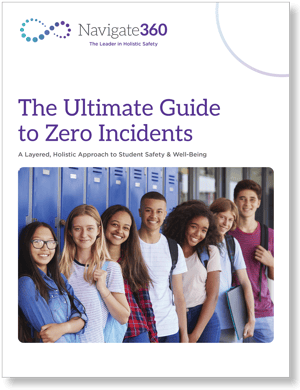
Today’s schools don’t need more disconnected tools. They need one layered approach—a platform that connects emergency response, campus operations, student behavior, and staff training into a single ecosystem built specifically for K–12.
Format
PDF
Length
10 pages
Read Time
~15 minutes
## Featured Solutions:
- Safety & Emergency Response
- School Operations & Movement
- Student Behavior & Well-Being
- Staff Training & Certification
Total protection for your school community.
### Download the guide to see how they work together.
What's in the guide
## One system. Four solution areas. 20+ solutions.
The Navigate360 Complete Solution Guide is your comprehensive resource for evaluating how Navigate360 addresses every dimension of K–12 safety—from the moment a visitor walks in the door to how your staff responds in a crisis:
01 Prevention. Preparedness. Real-time Response.
### Safety & Emergency Response
Emergency Management • Panic Button Alerting & Wearables • Digital Threat Detection • Anonymous Reporting System
02 Visibility. Accountability. Daily Efficiency.
### School Operations & Movement
Visitor & Volunteer Management • Hall Pass & Student Movement • Site Mapping • Risk Assessment • Security Audit
03 Early Intervention. Structured Support. Measurable Impact.
### Student Behavior & Well-Being
Behavioral Case Manager • PBIS Rewards • Behavior Referral System • Well-Being & Intervention Curriculum
04 Aligned Training. Compliance Clarity. Confident Staff.
### Staff Training & Certification
ALICE Active Shooter Response Training • Threat Assessment Training • Suicide Awareness & Prevention Training • Program Development & Operation • Safety & Compliance Certification • Professional Development
“
> Navigate360 Emergency Management increased accountability. Everyone at our schools knows exactly what to do in an emergency.
AB
Augie Ballesteros
Safety and Preparedness Supervisor
Douglas Unified School District
“
> I haven’t heard complaints about student accountability since \[PBIS Rewards & Hall Pass Plus\] implementation. My teachers are much happier and they’re not guessing where a student is anymore.
JT
Jake Thierjung
Principal
Samuel K. Faust Elementary
“
> Navigate360 \[Behavioral Case Manager\] is what allows us to have a centralized approach to suicide, threat risk prevention, and response in the district. We have 100% adherence to standardized procedures across 96 campuses with centralized oversight.
WB
Dr. Wes Baker, LP, LSSP
Mental Health Intervention Team
Cypress-Fairbanks ISD
“
> Navigate360 \[Threat Assessment Training\] gave us clarity, confidence, and control.
LS
Lori Sancin
Director of Pupil Services
Berea City Schools
“
> This kind of training \[ALICE Training\] isn’t easy, but it’s essential. By working through the hard stuff with a trained professional, you remove the confusion from an incident and regain control.
MC
Matthew LaSota
Dean of Students
Oxford Academy
“
> The trainer was a total Joy bomb! He made a PD on the last day before break fun and engaging! That is NOT easy to do!
FA
Florida Cyber Charter Academy
‹
›
What schools are saying
## Districts across the country. One trusted partner.
From large urban districts to small rural schools, Navigate360 is helping K–12 communities build safety infrastructure that works every day—not just in a crisis:
Safety & Emergency Response
### School Panic Button System That Works | Dallastown Area SD + Navigate360
MC
**Michael Coleman**
Director of Technology
Student Behavior & Well-Being
### How Fairfax School District Reduced Suspensions by 35% with Navigate360 Compass Curriculum
MG
**Moishe Garde**
Chief Administrator of Student Services
Ready to learn more?
## Get the Navigate360 Complete Solution Guide.
[Download the Guide →](https://info.navigate360.com/complete-school-safety-solution-guide#form)
[](https://navigate360.com/)
©2026 Navigate360. All rights reserved.
facebook-f icon linkedin-in icon Twitter icon instagram icon
- [Default HubSpot Blog](https://alicetraining-6581542.hs-sites.com/blog)
---
[](https://navigate360.com/)
123 Main Street, City, State 11111
Copyright © 2026, Navigate360
```json
{
"@context" : "https://schema.org",
"@type" : "VideoObject",
"caption" : {
"@type" : "MediaObject",
"contentUrl" : "https://info.navigate360.com/media-transcripts/214052576301/en.vtt",
"inLanguage" : "en",
"name" : "en Captions"
},
"contentUrl" : "https://6581542.fs1.hubspotusercontent-na1.net/hubfs/6581542/video_assets/214052576301/inherited/web_optimized.mp4",
"dateModified" : "2026-06-01T13:49:53.420Z",
"duration" : "PT1M11S",
"height" : 1080,
"name" : "School Panic Button System That Works _ Dallastown SD + Navigate360",
"thumbnailUrl" : "https://info.navigate360.com/hubfs/School%20Panic%20Button%20System%20That%20Works%20_%20Dallastown%20SD%20%2B%20Navigate360.mp4/medium.jpg",
"uploadDate" : "2026-06-01T13:49:07.983Z",
"width" : 1920
}
```
```json
{
"@context" : "https://schema.org",
"@type" : "VideoObject",
"caption" : {
"@type" : "MediaObject",
"contentUrl" : "https://info.navigate360.com/media-transcripts/193535446064/en.vtt",
"inLanguage" : "en",
"name" : "en Captions"
},
"contentUrl" : "https://6581542.fs1.hubspotusercontent-na1.net/hubfs/6581542/Navigate360%20x%20Fairfax%20School%20District%20Video.mp4",
"dateModified" : "2026-06-01T13:52:50.317Z",
"duration" : "PT1M51S",
"height" : 1080,
"name" : "How Fairfax School District Reduced Suspensions by 35% with Navigate360 Compass Curriculum",
"thumbnailUrl" : "https://info.navigate360.com/hubfs/Navigate360%20x%20Fairfax%20School%20District%20Video.mp4/medium.jpg",
"uploadDate" : "2025-07-28T15:21:51.777Z",
"width" : 1920
}
```