

Skip to content

● Digital Safety ● Guide

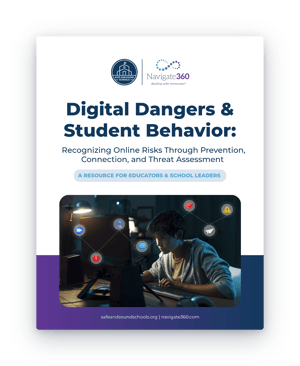
Digital Dangers & Student Behavior:

Recognizing Online Risks Through Prevention, Connection, and Threat Assessment

Students do not separate their online and offline worlds, and neither can schools. While many digital concerns begin outside of school, their impacts often show up inside classrooms, hallways, athletic fields, and the broader campus culture.

Format
PDF guide · 10 pages
 
Audience
Educators & school leaders
 
Focus
Digital risk & threat assessment
Digital Dangers & Student Behavior-Guide-080526-818x1052

Inside the guide

  • Why Digital Concerns Matter for School Safety
  • Understanding the Online Risks Students Are Navigating
  • Recognizing Digital Leakage and Warning Signs
  • The Importance of Reporting and Early Intervention

Free Download

Get the guide

Complete the form and the PDF will be delivered to your inbox.

Overview

Students do not separate their online and offline worlds.

The conversations students have, the content they consume, the communities they engage with, and the experiences they encounter online can influence their well-being, relationships, behavior, and sense of safety.

To explore these challenges, Safe and Sound Schools partnered with Navigate360 to present the webinar Digital Dangers & Student Behavior: When Low-Level Concerns Become Safety Risks, examining emerging digital threats affecting students today and how schools can identify concerns early, assess risk appropriately, and connect students with the support they need.

While the technologies continue to evolve, the goal remains the same: help schools recognize warning signs, strengthen reporting pathways, and intervene before concerns escalate into crises.

● Chapter 01

Why Digital Concerns Matter for School Safety

Digital activity is not the full picture, but it is a critical piece of the puzzle.

When discussions about school safety include digital environments, it can be tempting to focus solely on technology, but the technology itself is rarely the issue.

Digital spaces often provide insight into a student's experiences, stressors, grievances, relationships, and behaviors. They may reveal warning signs, opportunities for support, or indicators that a student is struggling.

The goal is not to determine whether a student is dangerous based on a single post, comment, search, or interaction. The goal is to identify concerns early enough to understand what may be happening and determine what support or intervention may be needed.

In that sense, digital activity should be viewed as one source of information within a broader prevention framework.

● Chapter 02

Understanding the Online Risks Students Are Navigating

Schools do not need to become experts in every emerging platform or technology. They do need systems that help adults recognize changes in student behavior, understand context, and connect students with appropriate support. Several emerging concerns schools should understand as they work to support students and families include:

Deepfakes and AI-Generated Content

Artificial intelligence has made it possible to create realistic videos and images with minimal effort. A single photo and a brief audio clip can now be used to generate convincing content that appears authentic. Recently reported incidents involve students being falsely implicated in misconduct, educators being targeted through manipulated videos, and AI-generated explicit images being created without consent.


AI Companions and Chatbots

Students are increasingly engaging with AI companions and chatbots for information and conversation. While many interactions are harmless, concerns related to students relying on AI for companionship or emotional support, as well as instances where chatbot safeguards can be bypassed through simple rewording.

Predatory Harms

Online predators are an ever-growing concern in the digital world. One threat is sextortion, a form of exploitation where someone is manipulated into sending sexual images, only to be blackmailed once those images are shared. These incidents often begin with what appears to be a peer-to-peer interaction before quickly escalating to requests for explicit images and subsequent blackmail.

Algorithmic Harms

Not all harmful content is actively sought out by students. The nature of recommendation algorithms increasingly shapes what students see online, often pushing content based on what students have previously engaged with. Students are rarely subjected to obviously dangerous or extremist content right away.

● Chapter 03

Recognizing Digital Leakage and Warning Signs

Research consistently shows that individuals considering violence often communicate their thoughts, grievances, frustrations, or intentions before taking action. In today's environment, those communications—referred to as digital leakage—frequently occur online.

According to Dr. Rahi, the responsibility of staff is not to determine whether a student poses a threat. Their responsibility is to recognize concerns and ensure they are reported through appropriate channels so they can be evaluated by trained professionals.

REMEMBER
  • A concerning statement is not the same as a threat
  • A threat assessment looks at behaviors, context, and intent
  • Early reporting creates opportunities for support

● Chapter 04

The Importance of Reporting and Early Intervention

Creating a culture where concerns are reported early is absolutely critical to prevention and intervention efforts. Many warning signs are first observed by peers. Students often know when a friend is struggling, becoming isolated, engaging in concerning online communities, or posting troubling content. For this reason, peer reporting remains one of the most valuable prevention tools available to schools.

Students should understand that reporting concerns is not about punishment. It is about helping someone get support before a situation worsens. Schools can strengthen prevention efforts by helping students understand:

What types of concerns should be reported

How to report concerns

Where to report concerns

What happens after a report is made

When students trust the process, they are more likely to use it.

Contributing Experts

Three practitioners behind the guide.

Kate Rahi

Kate Rahi, PhD, LMSW

Associate Director of Projects & Training
Safe and Sound Schools

Dr. Kate Rahi is a Licensed Master Social Worker with a focus in violence prevention, behavioral threat assessment and management (BTAM), and crisis response. With a career spanning education, law enforcement, and federal violence prevention initiatives, she has worked at the front lines of threat assessment in schools, served as a mental health clinician on a police co-responder team, and led strategic violence prevention efforts through the U.S. Department of Homeland Security.

Allison Willemin

Allison Willemin, Ed.D.

VP of School Safety Strategy, Technology, & Partnerships
Navigate360

With more than 23 years of experience in education, Dr. Willemin has served as a teacher, school administrator, and district-level leader. She co-founded the Oakland County School Safety Consortium and serves as Vice-President of the National Council of School Safety Directors.

Jess Campbell

Jess Campbell

Sr. Analytical Linguist
Navigate360

Jess Campbell is the Senior Analytical Linguist at Navigate360. Since 2019, she has helped shape and advance the Digital Threat Detection product. With a background in forensic linguistics, her work centers on understanding and operationalizing the language of risk to prevent harm before it occurs.

Recognize concerns early. Connect students with support.

©2026 Navigate360. All rights reserved.