
Skip to content

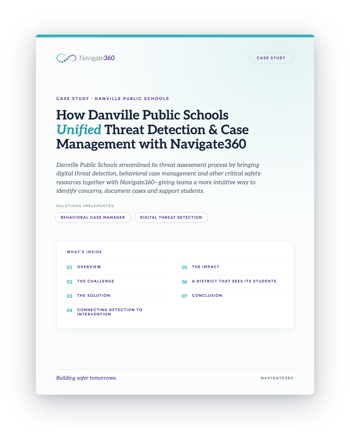
Case Study · Danville Public Schools

How Danville Public Schools Unified Threat Detection & Case Management with Navigate360

Danville Public Schools streamlined its threat assessment process by bringing digital threat detection, behavioral case management and other critical safety resources together with Navigate360—giving teams a more intuitive way to identify concerns, document cases, and support students.

Danville Public Schools serves more than 5,000 students in southern Virginia near the North Carolina border. As part of its broader school safety strategy, the district trains its threat assessment teams to use the Comprehensive School Threat Assessment Guidelines (CSTAG), giving administrators a consistent framework for evaluating and responding to concerning student behavior.

Although the district already had an established threat assessment process, Director of Safety and Security Jeff McLaughlin quickly discovered that the technology supporting it was making the work harder than it needed to be.

Format
PDF
 
Length
8 pages
 
Read Time
~10 minutes

Download your free copy

See how Danville Public Schools created a more connected path from early identification to assessment, intervention and continued support.

Danville Public Schools-Case Study-090326

You'll get:

  • The complete Danville Public Schools story
  • How a district configured Behavioral Case Manager around CSTAG, the model its principals already knew
  • How Digital Threat Detection alerts connect directly to Behavioral Case Manager
  • Why case information and history moving with the student matters when students change schools
  • Lessons learned from replacing a platform that worked against the district's training

What's Inside

A System Built for Their Team

Danville's previous threat assessment platform didn't follow the CSTAG workflow their principals had been trained on. Teams were able to complete the assessment on paper in one sequence, but when they opened the digital platform, they found the same questions organized entirely differently. It was clear that the district's training was not the problem, but rather the system teams were being asked to use.


They needed a solution that could:

  • Reflect the assessment models teams already knew
  • Reduce unnecessary navigation and duplicate steps
  • Centralize assessment records and student safety resources
  • Connect threat detection with assessment and follow-up
  • Keep staff focused on the student rather than the software

For Danville, that connection creates a clearer path from seeing a potential concern to understanding it and taking action.

01

Overview

A 5,000-student Virginia district with threat assessment teams trained on CSTAG.

02

The Challenge

Software that reordered the assessment and worked against the district's own training.

03

The Solution

Behavioral Case Manager configured around the asessment model principals already knew.

04

Connecting Detection to Intervention

Detection alerts that flow straight into the threat assessment plaform.

05

The Impact

One place for case history, with context that follows students who transfer.

05

A District That Sees Its Students

Why earlier visibility matters most to the student who needs support.

It has saved lives.
Jeff McLaughlin Director of Safety and Security, Danville Public Schools

Turning Early Signals Into Student Support

For Danville, the impact of a more connected approach ultimately comes down to what teams are able to see—and what they can do with that information.

Early indicators no longer have to stand alone. They can become part of a larger picture that includes assessments, case history, and previous interventions, giving authorized teams greater context when a student may need support.

That visibility has already made a difference in Danville. One of the first concerning alerts McLaughlin received ultimately helped connect a student with counseling support. It was an early example of what could happen when the right information reached the right people at the right time.

But for McLaughlin, the significance goes beyond any single alert or intervention. It is about making sure students know someone is paying attention.

Connect the signals. Strengthen the response.

 
See how Navigate360 can help your district connect early identification, assessment, and intervention so teams can act with greater visibility, confidence, and focus.

©2026 Navigate360. All rights reserved.